Share This Pattern :
The search for a good blanket pattern can be daunting, sometimes you think you found the one, start crocheting only to realize half way at 3:00 AM that’s this pattern is missing something, and you have to start over, it does not have to be this exhausting, especially when you’re on the rush to give the best baby blanket for the family’s newest arrival or to your loved ones.
Here in Crewchet we understand the struggle, so our team have complied the 10 best crochet stitch patterns for blankets, all beginner-intermediate friendly, all genuinely beautiful, to make your life easier, so without further ado, grab your hook and let’s get started.
1. Waffle Stitch

The waffle stitch is probably the most satisfying blanket stitch to work, every few rows you start seeing that gorgeous raised grid form, and it only gets better as the blanket grows. It uses front post and back post double crochets to push and pull stitches forward and back, creating that 3D woven look.
Best for: Chunky cozy throws, gift blankets, baby blankets.
The Pattern :
- Row 1 : Ch any multiple of 3 + 2. Work a double crochet (dc) into the 3rd chain from your hook, dc across.
- Row 2: Ch 2, turn, dc in the first st, fpdc, dc in the next 2 st, repeat (fpdc, 2 dc) till you have 2 remaining stitches, make fpdc and dc in the last one.
- Row 3: Ch 2, turn. 2 dc, 2 fpdc, dc, repeat (2 fpdc, dc) to last st, dc in the last one.
- Repeat Row 2 and 3 till you have you desired length.
This pattern take so much yarn, so be prepared.
Use a bulky yarn (size 6) for your first waffle stitch blanket, the squares are bigger and more satisfying, and it works up fast enough to keep you motivated.
2. Moss Stitch (aka Granite Stitch / Linen Stitch)
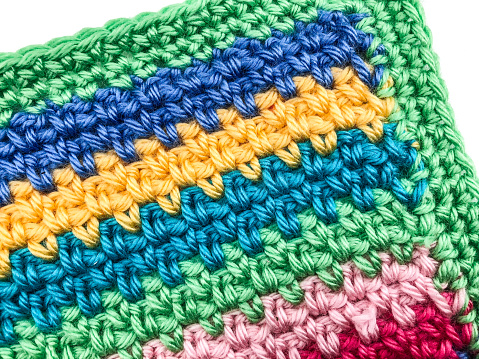
This stitch is dense, even, slightly woven-looking.
Best for: Modern minimal throws, baby blankets, lapghans.
The moss stitch has been having a serious moment in the crochet world and honestly, it deserves it. a simple two-stitch repeat that creates this neat, tightly packed texture that looks almost knitted. It’s incredibly meditative once you hit your rhythm, sc, ch 1, skip, repeat, and the fabric it produces has a beautiful matte, structured look.
It’s also one of the most beginner-intermediate friendly patterns on this list because there’s no counting beyond the repeat.
The Pattern :
- Ch an even number of sts.
- Row 1: Sc in 4th ch from hook, ch 1, skip 1, sc in next ch, repeat to end.
- Row 2: Ch 3, turn. Sc in first ch-1 space, ch 1, sc in next ch-1 space, repeat to end, sc in last st.
- Repeat Row 2 for pattern.
The moss stitch looks incredible in two alternating colors. Work 2 rows of each for a subtle woven stripe effect that looks like so much more effort than it is.
3. Ripple / Chevron Stitch
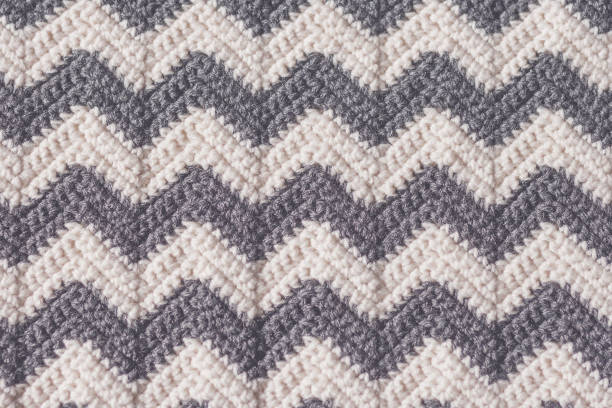
Wavy zigzag ridges, best used for colorful Afghans, striped throws, vintage-style blankets.
The ripple stitch is the one that started thousands of people’s crochet journeys, those bold, wavy stripes are iconic for a reason. The pattern alternates between increasing at the peaks and decreasing at the dips to create that satisfying chevron wave, and it works up faster than it looks.
What makes it especially good for blankets is that color changes are built into the design, you switch colors between rows, and suddenly a simple two-color yarn stash becomes a bold striped statement piece.
The Pattern :
- Chain a multiple of 12 + 3.
- R1: dc in the 4th ch, dc in the next 3 st, 2 dc dec (dip), 3 dc, 2 dc inc (peak), repeat till the last st, make a dc inc in it.
- R2: ch3 count as dc, dc in the first st – so now you have an inc in the first st, 3dc, make a dip (2 dc dec), 3 dc, peak (2 dc inc), repeat.
- You will always start and finish with a dc inc, repeat R 2 till the end.
- Change color every 2 rows for the classic ripple look.
Don’t panic when your ripple looks uneven in the first 3–4 rows. The wave only becomes obvious once you have a few inches of pattern established. Trust the process.
4. Bobble Stitch
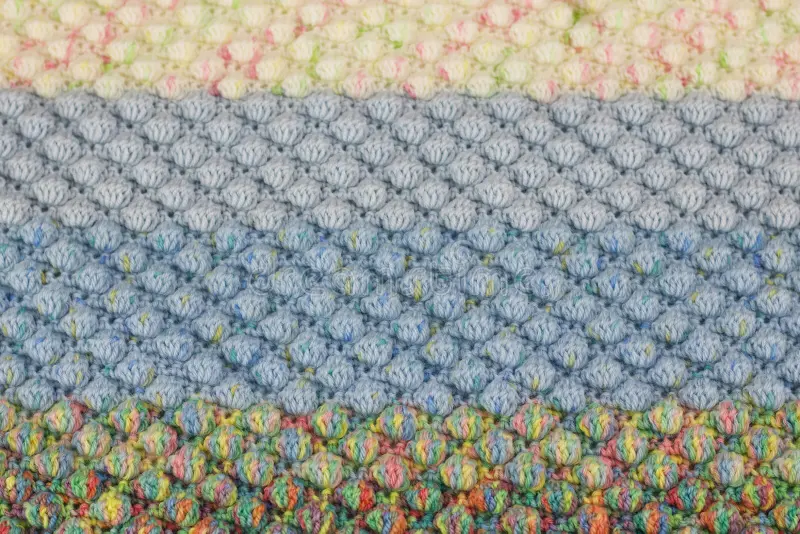
The stitch has a raised round bobbles texture scattered across a flat background.
Best for: Baby blankets, nursery throws, playful textured afghans.
Bobbles are pure joy to make. Each bobble is a little cluster of partially-worked double crochets all pulled together at the top to create a raised, round bump. On a flat double crochet background, they pop out like polka dots, and you can control the spacing to make them denser or more scattered.
How to make a bobble (5-dc bobble):
[Yo, insert hook in st, yo, pull up loop, yo, pull through 2 loops] 5 times in same st — yo, pull through all 6 loops on hook.]
Sample layout: work a foundation chain, then a row of dc in each st, the bubble row will always start and end with 2 sc, after making the 2 sc at the start of the 2nd row, make a bobble st, 3 sc, repeat till the last 2 st, make 2 sc. R3 is a dc row, and that’s it, just keep repeating these two row till you reach your desired height.
Bobbles always pop out to the back/wrong side as you work them, so flip your blanket over when you’re done and the “right” side will be full of gorgeous raised bobbles.
5. Granny Stripe Stitch
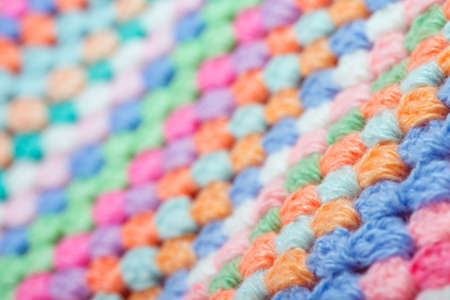
Best for: Colorful stash-busting blankets, boho throws, beginner-intermediate projects.
Everyone knows the granny square, but the granny stripe is what happens when you take that same cluster structure and work it in straight rows instead of squares. You get that iconic granny look, open, colorful, full of personality, without having to join any squares together.
It’s one of the best stitch patterns for using up leftover yarn because you change color every row and the open fabric means you’re not burning through yarn as fast as a dense stitch.
The Pattern :
- Ch a multiple of 3 +1.
- Row 1: dc in 4th ch from hook (the skipped 3 chains count as a dc), skip 2 ch, 3 dc in next ch, repeat (sk 2 ch, 3dc), end with 2 dc in last ch.
- Row 2: Ch 3, turn. 3 dc in first space between clusters, repeat, end dc in top of turning ch.
- Repeat Row 2, changing color each 2 rows.
Use the “no-join, no-cut” color change method — carry unused colors up the side of your blanket so you don’t have 50 ends to weave in when you’re done. you can add ch1- space in between clusters, I just do not like it.
6. Alpine stitch
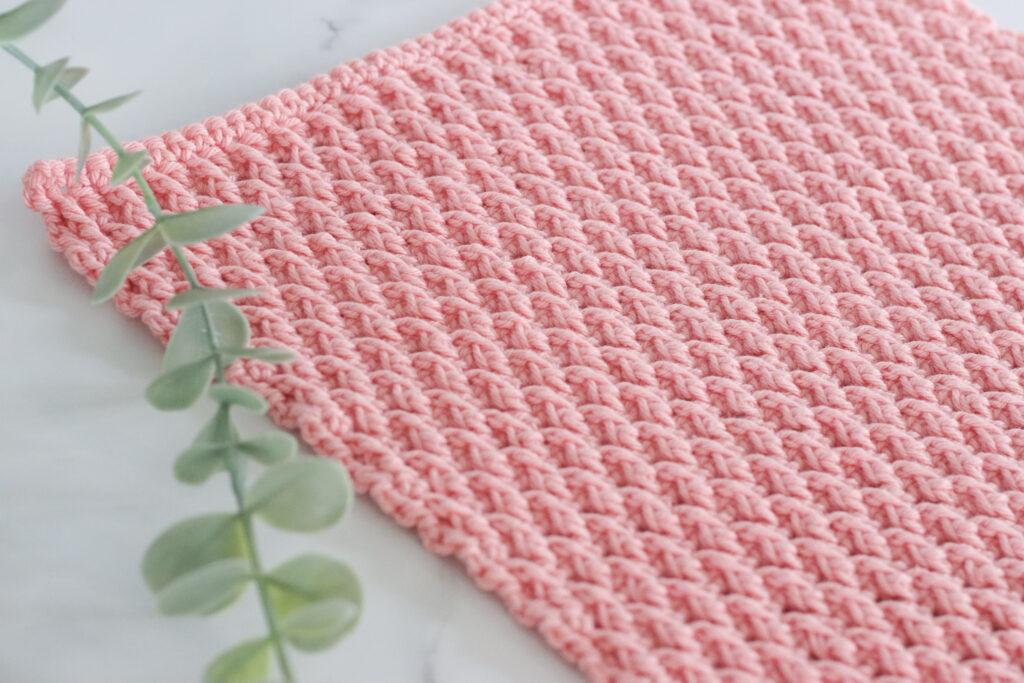
A rich textured stitch that combines regular double crochet with front-post double crochet to create a woven, almost knitted appearance. The raised ridges give blankets a beautiful, high-end look.
Best For:
Throw blankets, baby blankets, cushion covers, and projects where texture is the star. It works especially well with solid, tonal, or lightly variegated yarns.
The Pattern :
- ch multiple of 2 +1.
- R1: dc in the 2nd ch from the hook and across.
- R2: sc across.
- R3: dc, fpdc, repeat till the end of the row.
- repeat R2 & R3.
Mark the beginning of rows while learning, the stitch pattern is easy to follow once established but can be tricky to read at first. Also a worsted-weight or DK yarn usually gives the best balance of definition and drape.
7. Lemon Peel Stitch Blanket
A simple yet beautiful textured stitch created by alternating single crochet and double crochet stitches. The subtle texture resembles the dimpled surface of a lemon peel, adding visual interest without making the fabric bulky.
Best For:
Baby blankets, everyday throws, and beginner-friendly blanket projects. It works well for both modern and traditional designs and looks great in solid, striped, or variegated yarns.
The Pattern :
- chain an odd number.
- R1: sc, dc , repeat – the row starts and end with a dc.
- R2: ch1. turn, sc , dc , repeat.
- Repeat rows 2 for the rest of pattern.
Use smooth yarns and vibrant color if you want the texture to stand out more clearly.
8. Sedge Stitch
The Sedge Stitch combines single crochet, half double crochet, and double crochet into one repeat, creating a soft, slightly textured fabric that looks polished without being busy. It has excellent drape, making it ideal for blankets that feel cozy rather than stiff.
The Pattern
- chain multiple of 3.
- R1: (hdc,dc) in the 2nd ch from the hook, skip 2 ch, (sc, hdc, dc) in the same st, skip 2, (s, hdc,dc), repeat this sequence until the last st, make a sc in it.
Use a yarn with gradual color changes or long color runs. The stitch itself is simple, so subtle color transitions become the focus and make the blanket look much more expensive and complex than the actual stitch pattern.
9. Suzette Stitch
It has a dense, bumpy, seed-stitch look.
Best for:
Baby blankets, textured throws, projects where you want something different from the crowd
The Suzette stitch combines a single crochet and a double crochet worked into the same stitch, then alternates the pattern on the next row to create a dense, bumpy surface that resembles a knit seed stitch. It’s a real underdog stitch, not nearly as famous as it deserves to be, and blankets made with it have a wonderful weight and texture.
It’s also a great stitch for people who get bored, the subtle alternating pattern keeps your hands busy without being complex enough to stress you out.
The Pattern:
- Ch an odd number.
- Row 1: In 2nd ch from hook, (sc + dc) in same st, skip 1 – repeat to end, sc in last st.
- Row 2: Ch 1, turn. (sc + dc) in each sc of previous row, skip each dc – repeat, sc in last st.
- Repeat Row 2 for pattern.
Because every stitch is actually 2 stitches worked together, you use more yarn than most patterns. Go up a hook size or two from what your yarn label recommends to keep the fabric from getting too stiff.
10. Blanket Stitch Blanket Pattern
The Blanket Stitch creates a dense, cozy fabric with a gentle texture made from repeating groups of single and double crochets. It’s easy to memorize, works up quickly, and is a popular choice for baby blankets and throws.
The Pattern:
- chain a multiple of 3.
- R1: 2 dc in the 3rd ch from the hook, repeat [skip 2 ch, (sc, 2 dc) in the same st], finish with 1 sc in the last st.
- R2: ch2, turn, 2dc in the first st, repeat [skip 2 ch, (sc, 2 dc), inish with 1 sc in the last st.
- repeat R2.
The stitch pattern is simple enough that you can focus on maintaining even tension. If your double crochets start looking taller or looser than the rest, the texture becomes uneven very quickly, especially in solid colors.
How to Pick the Right One
Want the most texture? → Waffle stitch or Bobble stitch
Want the fastest result? → Granny Stripe or Ripple (especially in bulky yarn)
Want something that impresses non-crocheters? → Sedge stitch
Want to use up leftover yarn? → Granny Stripe or Ripple (color changes are built in)
Want something meditative with zero brain power? → Moss Stitch
Final Thoughts
The best stitch pattern for your blanket is honestly the one that excites you enough to keep going past row 10. Blankets are a commitment, pick something with a rhythm you enjoy, in a color you love, and the rest takes care of itself.
If I had to pick one to start with from this list? The moss stitch. It’s simple enough to feel confident but textured enough to feel like you learned something new. Once you’ve done a lap blanket in moss stitch, you’ll be hooked (pun fully intended) on stitch pattern blankets.
Which stitch pattern are you going to try first? Drop it in the comments, I’d love to know!
I would love to see yours! Join our Facebook group and share your finished project.
Follow us on Instagram | Facebook | Pinterest | Reddit
Subscribe to our YouTube channel for more tutorials.
Happy crocheting! 🧶